
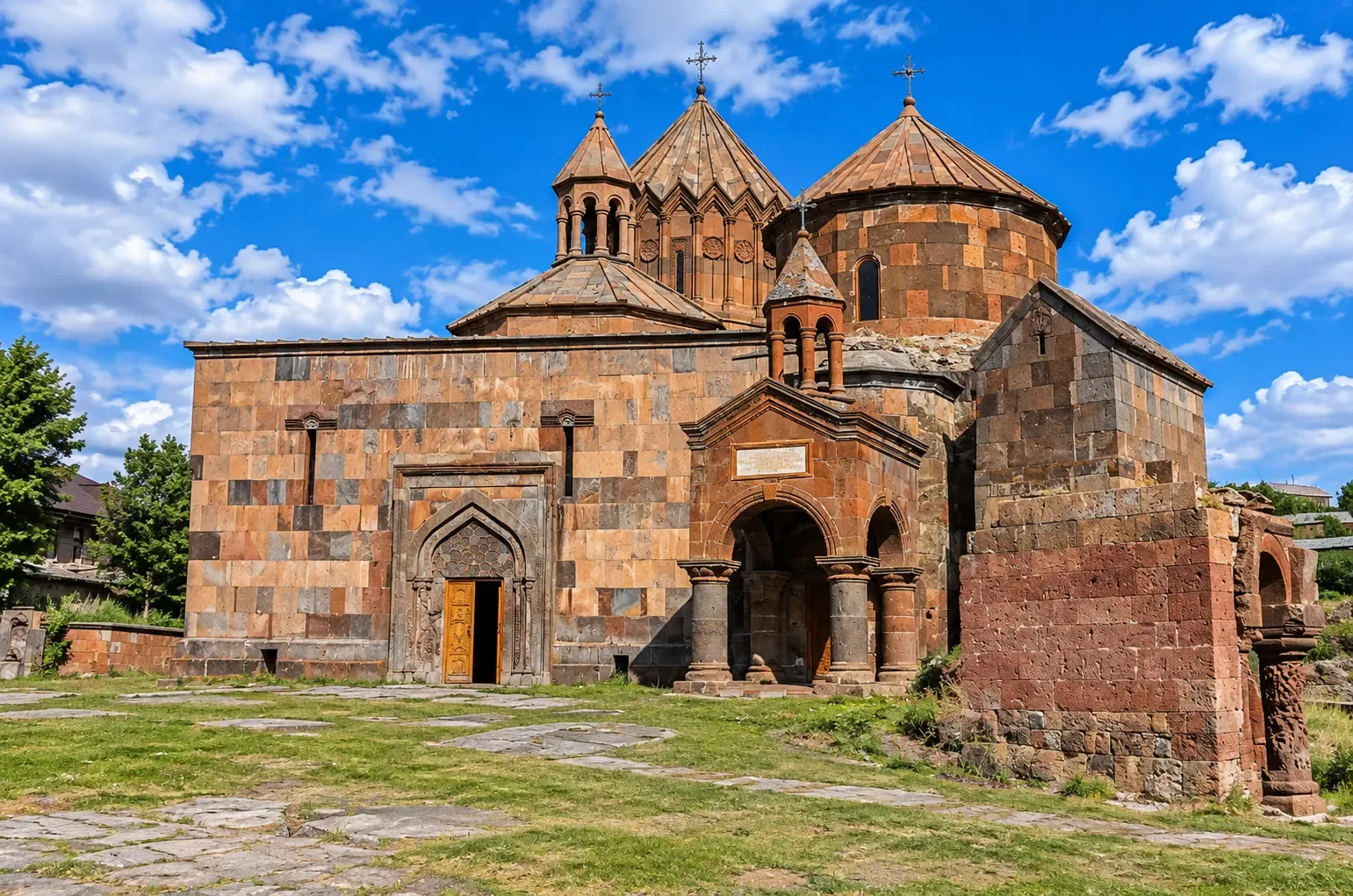
Harichavank Monastery (Հառիճավանք), also known as Harich Monastery, is located in the village of Harich in Armenia's Shirak Province, on the northern slopes of Mount Aragats. It is one of the significant monuments of medieval Armenian architecture, renowned for its centuries-old history, distinctive architectural features and important role in the country's religious and cultural life.
The history of the monastic complex dates back to the 7th century. Its oldest surviving structure is considered to be the Church of Saint Gregory the Illuminator. Although its exact foundation date is unknown, its architectural features and surviving inscriptions indicate that it was built in the 7th century. The church features a central domed, cruciform design characteristic of early medieval Armenian architecture. Its massive sixteen-sided dome drum is particularly impressive, giving the building a distinctive and monumental appearance.
In the early 11th century, the monastery suffered damage during the Seljuk invasions. In the 12th century, the complex was restored under the initiative of Abbot Grigor Vardapet. During this period, the monastery gradually regained its religious and cultural importance.
A new period of development began in the late 12th and early 13th centuries, when the monastery came under the patronage of the Zakarian princes. In 1201, Princes Zakare and Ivane Zakarian commissioned the construction of the complex's main church, Surb Astvatsatsin (Holy Mother of God), which became its central architectural structure. The monastery grounds were also enclosed by defensive walls.
The Church of Surb Astvatsatsin is a domed hall with two-storey chambers at its corners. Its architecture is distinguished by harmonious proportions, a complex dome structure and elaborate exterior decoration. The facades are adorned with stone rosettes, bird reliefs, ornamental patterns and sundials. Particularly noteworthy are the sculpted representations of Princes Zakare and Ivane on the eastern facade, offering a glimpse into the appearance of medieval Armenian nobility. Different shades of stone were used in the construction, creating a distinctive multicoloured masonry pattern.
The monastic complex also includes chapels, a gavit (church vestibule), a bell tower, and residential and auxiliary buildings. The monastery school and scriptorium are especially significant, as manuscripts were copied and educational activities developed there. During the 13th century, Harichavank became one of the region's important spiritual and cultural centres.
The monastery is also associated with prominent figures in Armenian culture. From 1886 to 1889, the renowned Armenian poet Avetik Isahakyan studied here. In 1850, Harichavank became the summer residence of the Catholicos of All Armenians, contributing to the expansion of the monastic complex. During the 19th century, additional buildings were constructed on its grounds, including residences for clergy, a school, a refectory and auxiliary facilities.
A local legend is also associated with the monastery and the Seljuk invasions. According to the story, local residents took refuge inside the church and later escaped through a secret underground passage leading to a nearby gorge. When the invaders entered the church, they found it empty and believed that the people had miraculously transformed into birds and flown away. This story became part of local folklore and has been passed down through generations.
Today, Harichavank is an important historical complex that combines monuments of early medieval and mature Armenian architecture. Its ancient churches, intricate stone carvings, historical inscriptions and surrounding mountain landscapes offer visitors an opportunity to discover significant chapters of Armenia's religious, cultural and architectural history.