
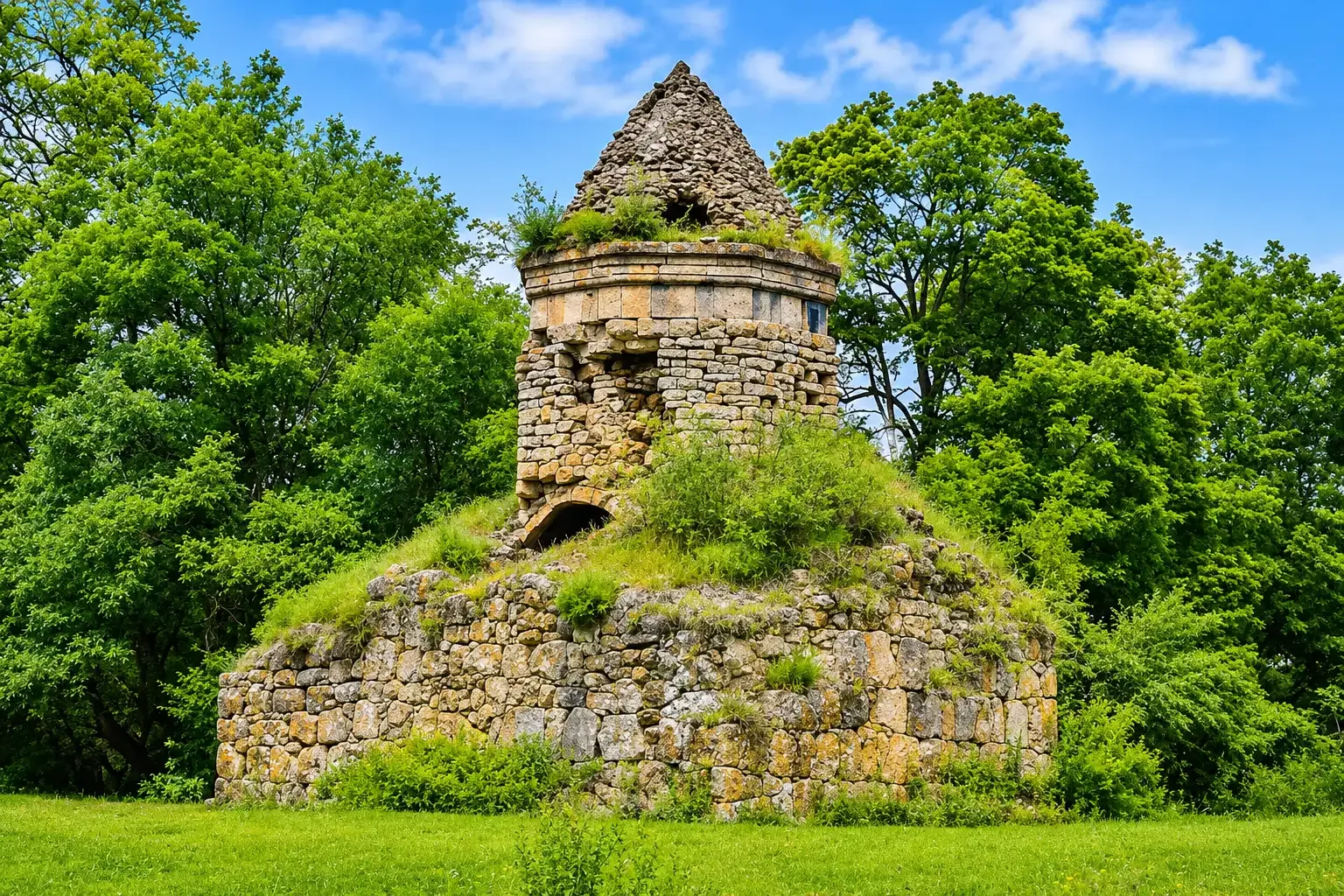
Kapavank Monastery – A Medieval Armenian Church Among the Forests of Tavush
Kapavank Monastery (Կապտավանք) is a historic Armenian religious complex located in Tavush Province, approximately 4–5 kilometers southwest of the village of Chinchin. It stands on a forested mountain slope along the right bank of the Khakhum River, surrounded by picturesque gorges and dense woodlands. The monument attracts attention with its unusual architecture, distinctive bluish basalt masonry, and restrained exterior design, which set it apart from many other medieval Armenian monasteries.
The monastery's original name, as well as the identities of its founders, architects, and main patrons, remain unknown. In surviving historical inscriptions, the monument is referred to by different terms, including church, monastery, and katholikon (main cathedral church). The name Kapavank, generally translated as "Blue Monastery," is believed to have appeared later and is associated with the characteristic bluish color of the basalt used in its construction. The main church is traditionally associated with Surb Astvatsatsin (Holy Mother of God), although its original dedication has not been conclusively established.
The history of Kapavank is documented through nine surviving stone inscriptions, four of which contain specific dates. These written records provide valuable information about the monastery's development and its importance in the religious life of the region during the 12th and 13th centuries.
One of the most significant dates is 1151, traditionally associated with the consecration of the church. It indicates that a religious structure already existed here by the middle of the 12th century. Other inscriptions contain information about donations made in 1234 and 1243. These records confirm that the monastery continued to operate during the 13th century and received support from benefactors.
An inscription dated 1292 holds particular historical importance. It mentions Khan Keghatu, who ruled between 1291 and 1295. This record provides valuable evidence of the Mongol presence in the region and helps explain the historical circumstances in which the monastery continued to function toward the end of the 13th century.
Historical and research sources offer different interpretations regarding the construction date of the main church. Some researchers associate its construction with 1151, while others point to the inscriptions from 1234–1243. The Tavush Tourism Development Agency also mentions 1349, based on a dated stone discovered near the church. However, its direct connection to the original construction has not been established, so this date cannot be considered definitive.
The main architectural feature of Kapavank lies in its unusual construction materials and masonry techniques. Unlike many medieval Armenian churches, which are characterized by carefully dressed stone blocks and elaborate carved decorations, this church is built almost entirely from basalt stones of various sizes with a distinctive bluish shade. The stones are mostly roughly shaped and joined together with lime mortar.
The church measures approximately 11.4 by 9.5 meters. Its interior follows a cruciform layout and includes four small corner chambers and a central domed space supported by four arches. The thickness of the walls varies from approximately 0.8 to 1.7 meters. The building has two entrances, located on its western and southern sides.
The architectural decoration is simple and almost entirely free of elaborate ornamental elements. The builders focused primarily on the natural beauty of the stone, its colors, and its texture. As a result, the church has a distinctive appearance in which the main visual elements are the masonry and the surrounding natural landscape.
The dome rests on four arches and is topped with a pointed roof. The cornice beneath its roof and the upper section of the drum are made of pink tuff. Researchers believe these elements may have been added during later repair and restoration works. The combination of bluish basalt and pink tuff creates an unusual contrast that distinguishes Kapavank from other examples of medieval Armenian architecture.
Originally, Kapavank was a complete monastic complex rather than an isolated church. According to architectural and epigraphic evidence, its grounds included the main church, a gavit (narthex), buildings for the monastic community, and a cemetery.
The appearance of the word "vank," meaning monastery, in one of the surviving inscriptions also confirms the existence of a monastic community here. It is believed that the complex may have been surrounded by a protective wall, although only limited traces of the original structures remain.
Today, the main church is the principal surviving building. Near its southwestern side, visitors can see the remains of the narthex and other structures. The surrounding grounds also contain ancient burial sites and khachkars — traditional Armenian cross-stones decorated with distinctive carvings and ornamental patterns. These features help illustrate the original scale of the monastic complex and its importance to the local religious community.
The stone inscriptions preserved at Kapavank are among its most valuable historical features. Researchers have documented nine inscriptions containing information about donations, monastic activities, and the development of the complex over several centuries.
One particularly interesting inscription dates to 1242–1243. It contains the Armenian word "գորգ" (gorg), meaning "carpet." This is considered one of the earliest known written appearances of this word in Armenian historical sources.
The history of Armenian carpet weaving dates back to ancient times. References to carpets can also be found in earlier written sources, including texts from the 5th century. However, the term "karpet" was predominantly used in those records. The appearance of the word "gorg" in the Kapavank inscription is particularly significant for studying the development of the Armenian language, traditional textile production, and medieval material culture.
The inscription from 1292 mentioning Khan Keghatu is equally important. It provides insight into the historical circumstances surrounding the monastery during the period of Mongol rule and serves as valuable written evidence of Tavush's political history.
Over the centuries, the monastery underwent several repairs and partial restoration works. Certain architectural elements, particularly in the upper sections of the church and the dome structure, indicate later modifications to the original building. However, detailed information about every restoration period has not survived.
According to the Tavush Tourism Development Agency, the monument was first described in modern historical documents in 1947. Despite its architectural and historical importance, the monastery gradually fell into decline. Most of its original buildings have disappeared, and today the church and the ruins surrounding it remain the principal evidence of its past.
In February 2025, the publication Tavush Media reported the signing of a memorandum between philanthropist Arman Malinyan and Armenia's Ministry of Education, Science, Culture and Sports. The agreement concerned cooperation in the preservation and restoration of Kapavank. Under its terms, the ministry was expected to provide architectural and scientific project documentation, as well as professional supervision, while the philanthropist undertook to finance the restoration works.
Today, Kapavank is an interesting destination for travelers wishing to discover the historical and architectural landmarks of Tavush Province. The monastery is located approximately five kilometers from the village of Chinchin, and the journey to it passes through forested mountain slopes, hills, and picturesque gorges.
A visit to the complex offers an opportunity to see its unusual basalt masonry, surviving architectural elements, ancient inscriptions, khachkars, and historic burial sites. Unlike the larger Armenian monasteries known for their monumental structures and elaborate decorations, Kapavank stands out primarily for its distinctive character and historical features.
Its importance lies not only in its architecture but also in the written records that reveal aspects of medieval Armenia's religious, linguistic, and cultural life. The appearance of the word "gorg" in a 13th-century inscription, the reference to Khan Keghatu, and the unusual construction materials make this monument particularly interesting to researchers and enthusiasts of Armenian heritage.
Kapavank offers an opportunity to discover a lesser-known chapter of Tavush's history, explore the distinctive features of medieval Armenian architecture, and experience the peaceful atmosphere of an ancient monastery surrounded by the forested mountain landscapes of Armenia.