
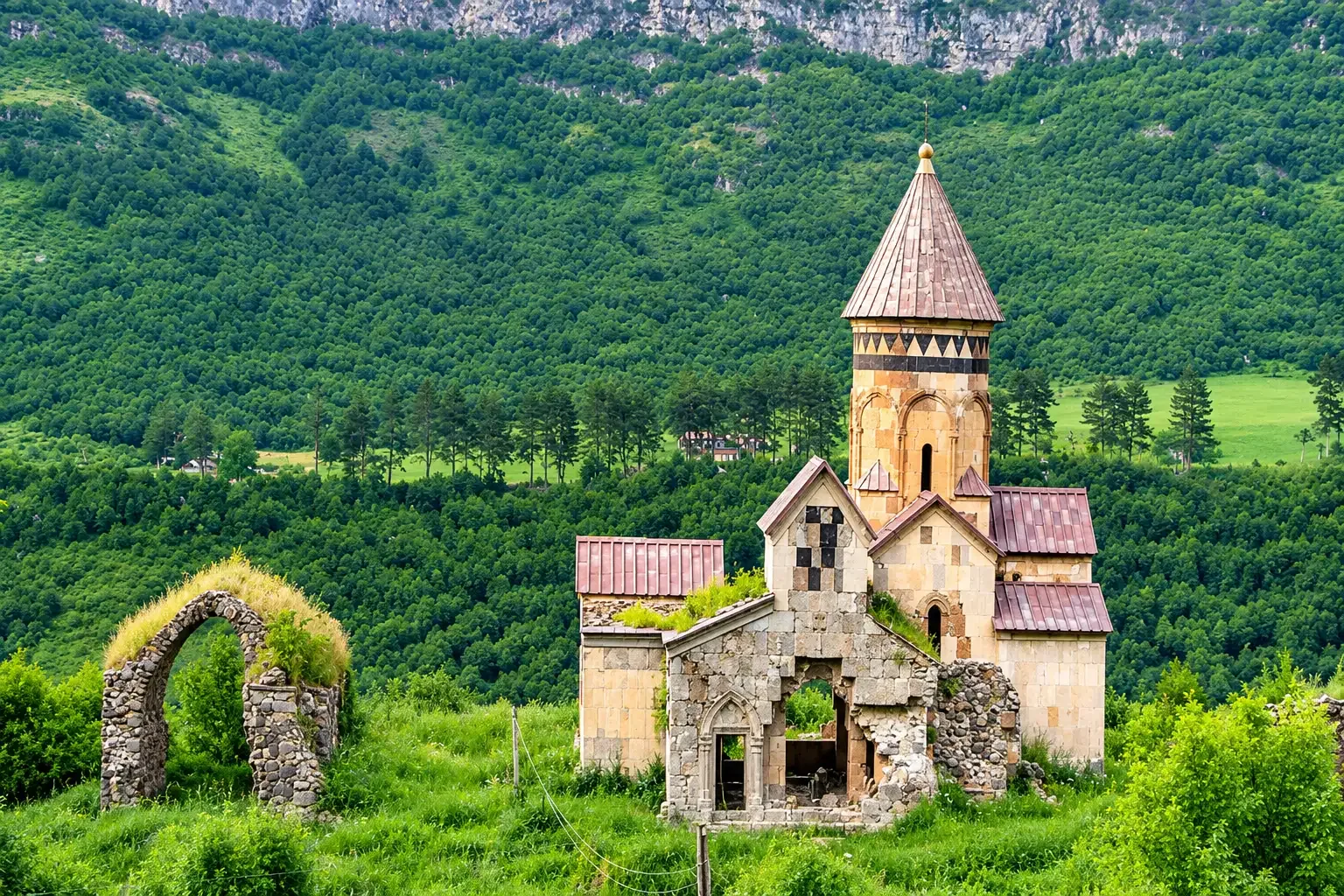
Hnevank Monastery is one of the remarkable monuments of medieval Armenian architecture, located in Lori Province, Armenia, near the village of Kurtan. The monastic complex stands on the right bank of the Dzoraget River, not far from its confluence with the Gargar River. Perched on elevated ground amid picturesque mountain slopes and deep gorges, it offers a striking combination of ancient architecture and natural beauty. Its secluded location gives the monastery a special atmosphere and provides a glimpse into the history of medieval monastic life in Armenia.
The history of Hnevank dates back to the 7th century, although its most significant architectural developments took place during the 12th and 13th centuries. Over the centuries, the monastery underwent several renovations and expansions, gradually acquiring distinctive features of medieval Armenian architecture. Prince Smbat Orbelyan played an important role in its development, supporting the reconstruction of the main church in the 12th century. This historical event is documented by a surviving Georgian inscription on the drum of the dome, which contains information about the prince's patronage and the restoration work.
The monastic complex consists of several religious and auxiliary buildings that once formed a unified architectural ensemble. The main church features a cruciform interior layout, three apses, and an octagonal dome drum. It was constructed using carefully dressed stone, while its proportions and decorative details reflect the architectural traditions of medieval Armenia.
Another church is attached to the southern side of the main building. It features a domed hall and a semicircular altar section. Its architecture complements the overall appearance of the complex and reflects the gradual expansion of the religious establishment. In addition to the two churches, the monastery once included a northern chapel, a gavit (narthex), and residential and utility buildings necessary for the everyday life of the monastic community.
One of the most interesting features of Hnevank is the collection of Georgian inscriptions preserved on its walls and architectural elements. These inscriptions are of particular historical importance because they reflect the close cultural, religious, and historical connections between Armenia and Georgia during the Middle Ages.
During the 12th and 13th centuries, the monastery was associated with the Chalcedonian Christian tradition, which was practiced in certain areas of northern Armenia and Georgia. This religious tradition influenced the spiritual life of the region, as well as the architectural and cultural characteristics of several monastic complexes. The surviving inscriptions provide valuable evidence of these historical developments and help researchers better understand the religious life of medieval communities in the region.
One of the important architectural elements of the monastery is its gavit, a traditional structure found in Armenian monastic complexes. These buildings were used for religious gatherings, ceremonies, and other church-related activities. The gavit at Hnevank was constructed between 1186 and 1206. Its approximate construction period is known thanks to a surviving building inscription above the entrance.
Although the gavit has only partially survived, its remaining architectural elements provide an idea of its original appearance and importance within the monastic ensemble. Such structures played an essential role in organizing monastic life and were a distinctive feature of medieval Armenian architecture.
Throughout its long history, Hnevank experienced periods of prosperity, abandonment, and destruction. Over time, several buildings within the complex were damaged, and the dome of the main church collapsed. Some structures have survived only as fragments of walls and foundations. Nevertheless, these remains still provide an understanding of the original scale and architectural composition of the monastery.
An important milestone in the preservation of this historical monument came in 2006, when restoration work began. As part of the reconstruction, the dome of the main church was restored and crowned with a cross. These efforts helped recover part of the church's original architectural appearance and preserve an important element of the monastic complex for future generations.
Today, Hnevank Monastery holds considerable historical and architectural significance. It is an important monument of Armenia's medieval heritage, preserving evidence of centuries of religious life, architectural development, and cultural interaction. Its ancient churches, remains of monastic buildings, distinctive architectural details, and Georgian inscriptions are particularly valuable for understanding the history of Armenian-Georgian relations during the Middle Ages.
The monastery's natural surroundings are equally impressive. Its elevated position among mountain slopes and deep gorges creates a picturesque setting for the ancient stone buildings. Visitors can enjoy beautiful views of the surrounding mountains and valleys, while the monastery's distance from large settlements gives it a peaceful and secluded atmosphere.
A visit to Hnevank Monastery is an interesting experience for anyone fascinated by history, medieval architecture, and Armenia's cultural heritage. Here, visitors can discover the traditions of ancient monastic construction, learn about the influence of different Christian traditions, and explore a historical monument that has preserved traces of Lori Province's rich past for many centuries.