
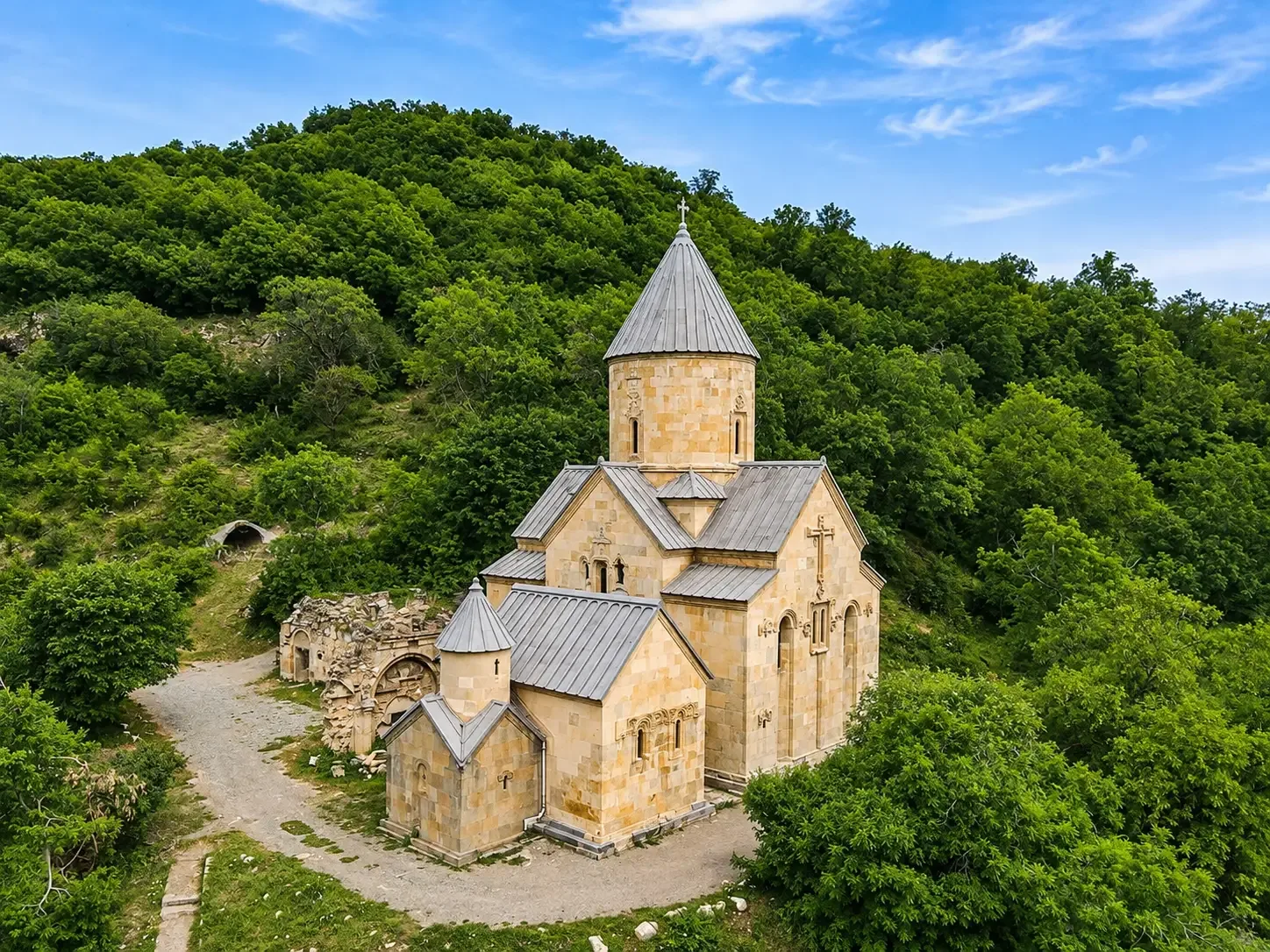
Varagavank Monastery, also known as Nor Varagavank (New Varagavank), is a remarkable monument of medieval Armenian architecture located in the Tavush Province of Armenia. The monastic complex stands approximately 3.5 kilometers southwest of the village of Varagavan, on a high rocky mountainside surrounded by dense forests and deep gorges. Thanks to its unusual location, rich history, and distinctive architectural details, it holds a special place among Armenia's historical landmarks.
Varagavank is one of the significant monastic complexes dating back to the 12th and 13th centuries and is closely associated with the history of the Kiurikian princely dynasty. For several centuries, it served as an important religious and spiritual center and was closely connected to the lives and family traditions of the ruling dynasty. Today, the monastery is particularly interesting to visitors who appreciate history, architecture, and Armenia's cultural heritage.
The history of the monastery dates back to the late 12th century. Between 1193 and 1198, Prince David II Kiurikian, ruler of Nor Berd and a representative of the junior branch of the Armenian royal Bagratuni dynasty, established a monastic community at this location. Initially, it was called Anapat, a name that translates from Armenian as "hermitage" or "isolated place."
The first structure built within the complex was a small single-nave church with two altars. Its construction was completed in 1198. The church featured an unusual interior layout: the eastern altar section was divided by a partition into two unequal spaces. On either side of the western entrance stood decorated khachkars, traditional Armenian cross-stones that represent an important part of the country's religious art.
In 1200, a family burial chapel for the Kiurikian princes was added to the northern side of the original church. As a result, the monastery acquired not only religious significance but also dynastic importance, becoming the burial place of members of the princely family. Later, a small single-nave chapel was constructed near the southern wall of the first church.
Over the following decades, the monastery gradually expanded. Members of the Kiurikian family actively supported its development, financed the construction of new religious buildings, and helped transform the complex into one of the region's important spiritual centers.
The main architectural landmark of Nor Varagavank is the Church of Surb Astvatsatsin, dedicated to the Holy Mother of God. Located in the northern section of the monastic complex, it was constructed between 1224 and 1237. The construction was financed by Prince Vasak II Kiurikian, the son of the monastery's founder, David II.
The surviving construction inscriptions provide information about the church's building history. One inscription near the western entrance dates to 1224, while another indicates that construction was completed in 1237. According to historical accounts, the church was consecrated in 1240 under the direction of Archbishop Hovhannes T'uetsi.
Architecturally, the church is a domed hall with a rectangular exterior and a cruciform interior layout. Its design includes four two-story side chapels, or sacristies, positioned at the corners of the building. The central section is crowned by a dome resting on a cylindrical drum.
The church has two entrances, one on the western side and another on the southern side. The southern portal deserves particular attention, as it is considered one of the most original examples of decorative design in medieval Armenian architecture. Its distinctive appearance sets the church apart from other religious buildings of the 13th century.
The surface of the southern entrance is decorated with differently colored stones arranged into an elaborate mosaic composition. Dark purple and light blue elements form intricate geometric patterns featuring stars, hexagons, and diamonds. Some individual stone details are also decorated with animal figures and delicate floral ornaments.
The combination of different stone colors, geometric shapes, and decorative carvings creates an extraordinary artistic effect. This design is one of the most remarkable features of the Church of the Holy Mother of God and demonstrates the exceptional craftsmanship of medieval Armenian architects and stonemasons.
Inside the church, a construction inscription bearing the name of a master craftsman from Ani has been preserved. It reads, "Master Ghazan from Ani." Researchers associate him with the architectural decoration of the church based on this inscription. However, the exact extent of his involvement in the design and construction of the building has not been definitively established.
The Holy Cross relic, known as the Varag Cross, occupies a particularly important place in the history of Nor Varagavank. Its story is closely connected with the spiritual traditions of the Armenian Apostolic Church and played a significant role in the monastery's new name.
According to church tradition, a fragment of the True Cross of Christ was brought to Armenia by the holy virgins Hripsime and Gayane. The sacred relic was later kept at the famous Varagavank Monastery, located on Mount Varag in the historical region of Vaspurakan, near Lake Van.
During the 13th century, when Varagavank Monastery faced military threats, it became necessary to protect its Christian relics and other valuable religious objects. As a result, the Varag Cross, together with other sacred items, was transferred to Anapat Monastery. Historical sources mention the abbot Luka, also known as Ghukas, who supervised the transfer of the religious treasures.
The exact date of this event remains a subject of historical discussion. Different sources mention 1213, while others associate the transfer with events surrounding the Mongol invasions of the 13th century. Therefore, establishing one definitive date for the relocation of the relic remains difficult.
Following the arrival of the sacred relic, Anapat Monastery received a new name: Nor Varagavank, meaning "New Varagavank." The name emphasized the spiritual continuity and historical connection between the two monasteries, which were located in different parts of historical Armenia.
The Varag Cross held special significance for the Armenian Apostolic Church. Its presence enhanced the monastery's spiritual importance and transformed it into an important place of veneration for one of the Christian relics associated with Armenian history.
During the 13th century, the monastic complex continued to develop and expand with the addition of new architectural structures. One of the most significant additions was a large rectangular gavit, or narthex, constructed on the western side of the main church. Its construction took place between 1237 and 1261 under the initiative of the monastery's abbot, Hovhannes T'uetsi.
The gavit played an important role in monastic life. It was used for religious gatherings, church ceremonies, and other events associated with the activities of the monastic community. Thanks to its dimensions and architectural composition, this structure belongs to the group of large gavits characteristic of medieval Armenian architecture.
Originally, the monastic complex had two gavits. However, only one has survived to the present day, while the second has been reduced to ruins. Despite the partial destruction, the remaining architectural elements provide an idea of the monastery's original scale and layout.
In 1253, a water supply system was established within the monastery grounds. According to surviving historical accounts, its construction is associated with a person named Shara. The presence of an independent water supply system demonstrates the relatively advanced infrastructure of the monastery and the careful organization of everyday life for its inhabitants.
In addition to the main religious buildings, two separate chapels are located approximately 100 meters southwest of the central part of the complex. A medieval cemetery lies nearby. Visitors can also see the remains of the monastery walls and former buildings that monks once used for various domestic and practical purposes.
Nor Varagavank is historically significant not only for its churches, gavits, and chapels but also for its numerous khachkars, which form an essential part of Armenia's cultural and spiritual heritage.
Khachkars are traditional Armenian carved stone monuments featuring crosses and intricate decorative patterns. They hold special significance in Armenian art and were often created to commemorate important events, honor distinguished individuals, or express religious devotion.
One of the best-known surviving khachkars within the monastery grounds dates back to 1620. It is attributed to a master craftsman named Vardan. This monument is particularly interesting because it demonstrates that artistic and religious traditions continued at the monastery for several centuries after its foundation.
The numerous construction and commemorative inscriptions preserved on the monastery buildings and stone monuments are equally valuable. They contain the names of princes, benefactors, abbots, and craftsmen, as well as important information about the construction and development of individual parts of the complex.
The inscriptions dating to 1224 and 1237 are particularly significant because they are associated with the construction of the Church of the Holy Mother of God. These historical records allow researchers to establish the main stages of the church's construction more accurately and determine the role played by Prince Vasak II Kiurikian in the monastery's development.
During the Middle Ages, Nor Varagavank was one of the important spiritual and religious centers of northeastern Armenia. It was closely associated with the Kiurikian princely dynasty and served as a place reflecting the religious traditions, family history, and political influence of this ruling family.
The monastery also occupied an important position in the region's ecclesiastical life. Its gradual architectural development, the construction of new churches and gavits, the presence of an independent water supply system, and the family burial chapel demonstrate that it was a fully developed monastic complex with established internal infrastructure.
Its connection with the Varag Cross was particularly significant. The arrival of this sacred relic strengthened the monastery's spiritual authority and established it as an important place of religious veneration. As a result, the history of Nor Varagavank became closely connected not only with the Kiurikian princely dynasty but also with the broader history of the Armenian Apostolic Church.
Today, Nor Varagavank remains one of the valuable monuments of Armenia's medieval architectural, historical, and religious heritage. Despite partial destruction, several important structures have survived, including the main Church of the Holy Mother of God, the earlier Anapat Church, the gavit, individual chapels, khachkars, and the remains of other monastic buildings.
The monastery attracts attention not only because of its centuries-old history but also because of its distinctive architectural features. Among its most remarkable elements are the mosaic decoration of the main church's southern portal, the domed composition of the building, ancient construction inscriptions, and intricately carved stone ornaments.
Its location on a forested mountainside gives this historical site a particularly distinctive atmosphere. The monastery is surrounded by dense vegetation, rocky formations, and deep gorges in the Tavush Province, allowing its architecture to blend harmoniously with the natural environment. Its secluded setting and picturesque scenery create a peaceful atmosphere and allow visitors to experience the historical character of this medieval religious community.
Visiting Nor Varagavank offers an opportunity to explore the history of the Kiurikian princely dynasty, learn more about the development of Armenian ecclesiastical architecture during the 12th and 13th centuries, and discover the fascinating history of the Varag Cross. This remarkable monastic complex is especially valuable for anyone interested in Armenian history, ancient architectural monuments, and the country's rich spiritual heritage.