
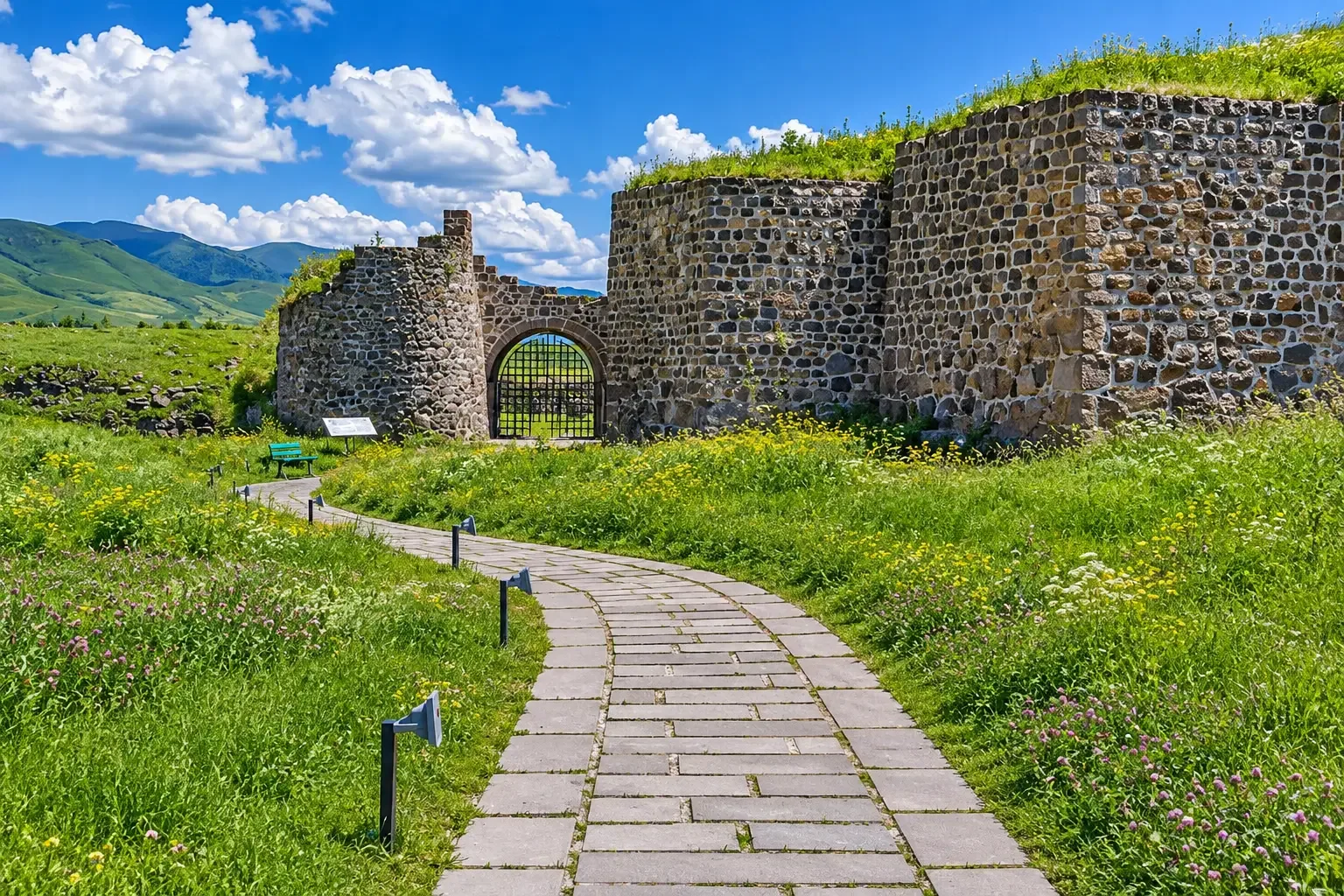
Lori Fortress, also known as Lori Berd, is one of the most significant historical monuments of medieval Armenia. It is located near the town of Stepanavan in Lori Province. Founded in the 11th century by King David Anhoghin of the Kiurikian dynasty, the fortress eventually became the capital of the Kingdom of Tashir-Dzoraget. Its strategic position on a high plateau surrounded by the deep gorges of the Dzoraget and Miskhana rivers provided natural protection and made it an important military and political center of the region.
During its golden age, Lori was not merely a fortified stronghold but a fully developed medieval city with an extensive infrastructure. Its territory included a citadel, residential districts, religious buildings, craft workshops, and commercial areas. The city was surrounded by massive stone walls reinforced with defensive towers and fortified entrances. Additional protection was provided by steep slopes and deep gorges, which made access to the settlement extremely difficult for potential enemies.
Lori played a particularly important role during the reign of David Anhoghin and his successors. Throughout the 12th and 13th centuries, the city remained one of the leading political, economic, and commercial centers of Northern Armenia. Thanks to its geographical position, it stood along important trade routes connecting different parts of the Caucasus.
In 1118, the lands of the Kingdom of Tashir-Dzoraget came under the rule of Georgian King David IV the Builder. Despite these political changes, Lori continued to maintain its strategic and administrative importance. However, during the 13th century, the city experienced Mongol invasions, which significantly affected its subsequent history and development.
Numerous architectural and archaeological monuments have survived within Lori Berd, allowing visitors to imagine the scale of this once-thriving medieval city. The discovered structures include the remains of palace complexes, residential buildings, churches, chapels, defensive towers, and auxiliary buildings. These ruins provide evidence of an advanced urban lifestyle and the high level of architectural craftsmanship of the period.
The medieval bathhouses are particularly interesting, featuring an underfloor heating system. Their construction demonstrates the engineering knowledge and understanding of comfort possessed by the city's inhabitants. Archaeological investigations have also uncovered elements of water supply and drainage systems, pools, fountains, and other structures that supported the city's infrastructure.
One of the notable historical landmarks near the fortress is a medieval stone bridge crossing the Dzoraget River. It served as an important part of the transportation network, connecting different territories. Its location and architectural features help illustrate the importance of roads and trade routes in the economic and social life of medieval Lori.
The history of the fortress continues to unfold through archaeological research. Excavations conducted in recent years have revealed additional sections of medieval urban development, fragments of paved roads, water structures, and further elements of the defensive system. These discoveries help researchers gain a deeper understanding of the city's layout, the daily lives of its inhabitants, and the level of construction and engineering technology in medieval Armenia.
Today, Lori Berd is an important historical and cultural monument that preserves evidence of the political, economic, and architectural development of medieval Armenia. The remains of its fortress walls, ancient buildings, archaeological discoveries, and surrounding natural landscapes offer a glimpse into the past of one of the region's largest medieval urban centers.
The deep gorges surrounding the plateau, mountain slopes, and panoramic views of the river valleys give this place a particularly distinctive atmosphere. Visiting Lori Fortress offers an interesting journey for those passionate about history, ancient architecture, and Armenia's cultural heritage. Here, visitors can explore the past of a medieval city, learn more about the Kingdom of Tashir-Dzoraget, and discover one of the most important historical attractions of Lori Province.