
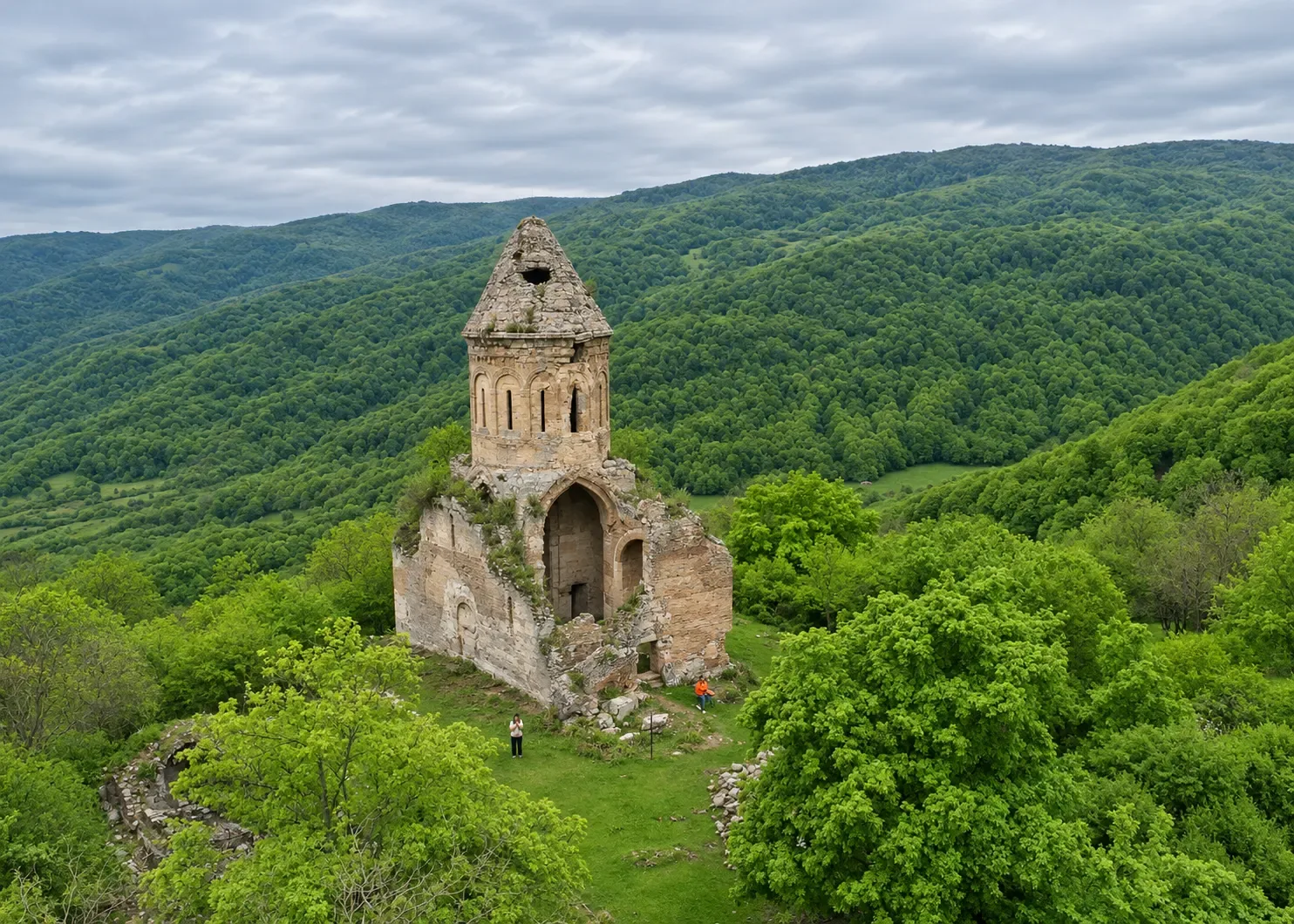
Srvegh Monastery is a medieval Armenian monastic complex located approximately three kilometres southwest of Aygehovit village in Armenia's Tavush Province. It stands on a forested hillside in an area known as Khachi Tak (Under the Cross). The monastery attracts attention for its unusual architecture, the use of fired brick and the surviving traces of medieval monastic life.
The complex dates primarily to the 13th–14th centuries, although certain architectural and epigraphic evidence suggests earlier phases of construction. The exact foundation date and the names of its founders have not been reliably established. Srvegh was one of the religious and cultural centres of the historical Kayen region and was associated with Armenian Chalcedonians, communities that followed the Chalcedonian Christian tradition. The monastery developed during the period of the Zakarian princely dynasty, when religious buildings were actively constructed and restored throughout the region.
The main structure of the complex is the Church of Surb Nshan (Holy Sign), which stands out because of its unusual building material in the context of Armenian church architecture. The main part of the building was constructed from fired red brick, while the lower rows of its walls are made of carefully dressed dark pink andesite. This combination gives the church its distinctive appearance and makes it one of Armenia's rare medieval brick monuments. A similar construction tradition can also be found at Kirants Monastery.
The Church of Surb Nshan belongs to the domed hall type. Its architectural composition includes an eastern altar apse, side chambers and a polygonal drum crowned with a pointed dome. The interior features architectural elements characteristic of medieval Armenian churches. Fragments of carved stones and khachkars from different periods have survived on its walls. Researchers believe that some of these elements belonged to an earlier structure and were reused during the construction or renovation of the church.
The history of the main church has not been fully established. An inscription discovered on one of its architectural elements was associated by researcher Samvel Barkhudaryan with the names of master builders Hovhannes and Sargis and the date 1152. However, whether this inscription belongs specifically to the present church remains a subject of scholarly discussion. Therefore, the exact construction date of Surb Nshan cannot be considered definitively established.
North of the main church stands the Chapel of Surb Astvatsatsin (Holy Mother of God). Unlike the medieval church, this chapel was built much later, in 1889. It is a single-nave structure with relatively simple architectural decoration. Fragments of ancient khachkars and carved stones were incorporated into its walls, while large gravestones have survived on its floor.
In addition to the churches, the monastic complex included residential and utility buildings, monastic cells and an oil mill. The grounds were surrounded by a defensive wall, of which mainly the foundations have survived. Outside the monastery walls are the remains of other structures, a medieval cemetery and khachkars. These architectural and archaeological features indicate that Srvegh was not simply a small religious building but a fully developed monastic settlement with its own infrastructure.
The monastery's water supply system is particularly interesting. Archaeologists discovered surviving fragments of clay pipes through which water was transported from nearby mountains. This demonstrates the careful organisation of everyday monastic life and the presence of engineering structures necessary for the community's functioning.
In 2021–2022, archaeological investigations, clearance and improvement works were carried out at Srvegh as part of a government programme for the preservation of historical and cultural monuments. An expedition led by Meri Safaryan studied the architectural structures and partially investigated the monastery grounds. One important finding was that the main church stands directly on natural rock, and the collapse of its structures was caused by earthquakes rather than instability of the foundation. The research also confirmed that during the medieval period the monastery had a considerable community and played a notable role in the religious and cultural life of the region.
Today, Srvegh Monastery is a partially ruined but historically and architecturally valuable monument of Armenia's medieval heritage. Its unusual brick church, remains of monastic buildings, ancient khachkars and water supply system provide insight into medieval Armenian religious architecture and everyday monastic life. Its secluded location among the forests of Tavush creates a distinctive atmosphere and makes it an interesting destination for travellers interested in history, architecture and Armenia's cultural heritage.