
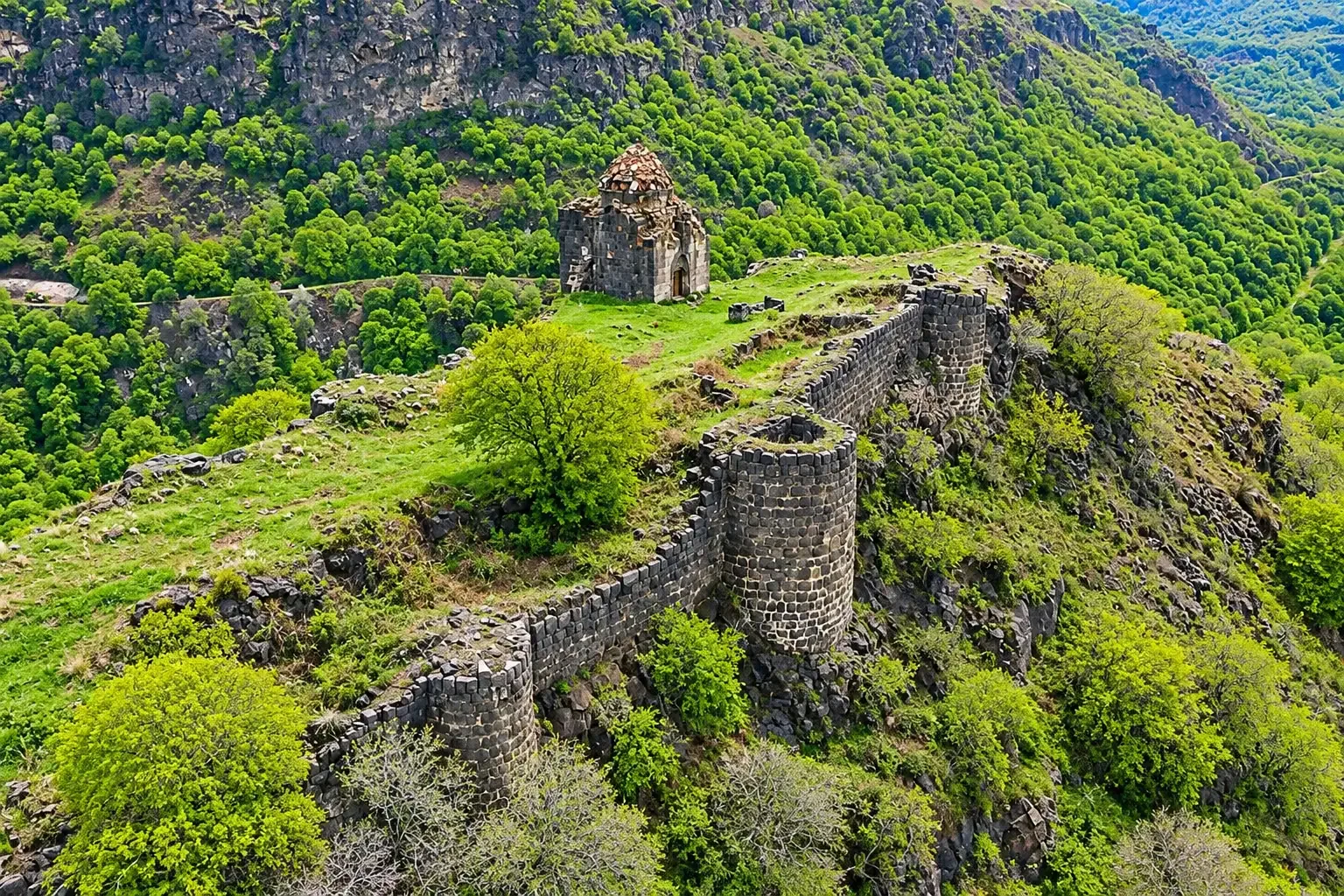
Kayanberd Fortress is one of Armenia's remarkable monuments of medieval military architecture, located in Lori Province, between the villages of Haghpat and Akner. It stands on a narrow rocky promontory overlooking the deep gorge of the Debed River, occupying a strategically advantageous position among mountain slopes and steep cliffs. Thanks to its location, the fortress served not only an important defensive purpose but also offered commanding views of the surrounding mountains, forests, and river valleys. Today, its ruins attract travelers interested in Armenian history, medieval fortifications, and the picturesque natural attractions of Lori Province.
The history of Kayanberd is closely connected with Haghpat Monastery and the events of the 13th century. According to a construction inscription preserved above the entrance to the church within the fortress, the stronghold was built in 1233 by Bishop Hovhannes, the abbot of Haghpat Monastery and a member of the Zakarian princely family. Originally, the fortress was called "Amrots Akhpata Surb Nshan," which translates as "The Fortress of Haghpat's Holy Sign." Over time, it became known as Kayanberd, the name by which the monument is recognized today.
However, the history of the fortification probably began much earlier. Medieval written sources mention a fortress that once stood on this site and was destroyed by the Seljuks in 1178. Several decades later, in 1233, Bishop Hovhannes rebuilt the defensive structure, transforming it into an important strategic stronghold. Its primary purpose was to protect Haghpat Monastery and the surrounding settlements from enemy attacks. During the 13th century, the fortress also suffered damage during the Mongol invasions, but its surviving ruins still provide insight into its original defensive design.
The location of Kayanberd was carefully selected to take advantage of the natural terrain. The fortress occupies a narrow rocky promontory surrounded by deep gorges on three sides. These natural barriers made approaching the stronghold extremely difficult and provided additional protection against attacks. Its elevated position allowed defenders to monitor a considerable stretch of the Debed Gorge, observe the movement of people and troops, and identify potential threats in advance.
The fortress had a carefully designed defensive system. It consisted of massive stone walls, fortified entrances, and approximately fifteen semicircular towers that strengthened its perimeter. An additional internal wall divided the territory into two main sections. The southern section occupied a higher part of the rocky promontory, while the northern section was situated closer to the edge of the gorge. This architectural arrangement made it possible to establish multiple defensive layers and continue protecting the inner areas even if an enemy managed to breach the outer walls.
Kayanberd was not simply a military fortification but a small fortified settlement equipped with the facilities needed for extended habitation. Inside the fortress were residential and utility buildings, accommodation for the military garrison, water reservoirs, and other structures essential for everyday life. The water supply system is particularly noteworthy. Water was transported from a nearby mountain through underground pipes made of fired clay. Remains of the pipeline and reservoirs were discovered during archaeological investigations, demonstrating the relatively advanced engineering infrastructure of the fortress.
One of the most historically significant structures within Kayanberd is the Church of the Holy Mother of God, known in Armenian as Surb Astvatsatsin and also referred to as Dsevank. It is located in the southern section of the fortress and is a small domed church with a cruciform interior layout and a rectangular exterior. Despite its modest dimensions, the church displays characteristic features of medieval Armenian architecture and occupies an important place within the historical complex.
The construction inscription preserved above the church entrance is of particular historical importance. It is associated with the construction of Kayanberd in 1233 under Bishop Hovhannes. Another notable feature is the stone lintel above the entrance, which consists of three separate pieces. The central stone is decorated with a relief resembling the shape of a cross. Such decorative details reflect the religious traditions and artistic characteristics of medieval Armenian architecture.
The church is also connected with the history of a revered Christian relic: a fragment of the True Cross of Jesus Christ, known as the Holy Sign of Haghpat. According to historical accounts, the sacred relic was kept in a special niche near the church altar. During periods of military danger, it was transferred from Haghpat Monastery to the fortress, where it could be protected behind the fortified walls. The original name of Kayanberd, "The Fortress of Haghpat's Holy Sign," is directly associated with this relic. Today, the fragment of the Cross is kept in the main church of Haghpat Monastery.
Throughout its centuries-long history, the church experienced several destructive events. In 1827, it was damaged by a powerful earthquake that caused its dome to collapse. Later, a local resident from the village of Haghpat, Marg ar Yerznkyan, undertook the restoration of the damaged section. Thanks to his efforts, the church was preserved, although some of its architectural elements no longer fully reflect the building's original appearance.
Today, Kayanberd Fortress is a valuable monument of Armenia's historical and architectural heritage. Despite its partial destruction, the surviving sections of defensive walls, towers, the ancient church, and the water supply system provide an understanding of the construction principles and organization of medieval military fortifications. Its historical connection with Haghpat Monastery, one of medieval Armenia's most important spiritual and cultural centers, adds particular significance to the site.
A visit to Kayanberd can be combined with a trip to Haghpat Monastery, allowing travelers to explore the history of Lori Province and its architectural heritage in greater depth. These two monuments are closely connected through historical events and represent different aspects of medieval Armenian life: its spiritual and defensive traditions.
Beyond its historical and architectural importance, the fortress attracts visitors with its remarkable position above the Debed Gorge. Its grounds offer impressive panoramic views of steep cliffs, mountain forests, winding river valleys, and surrounding settlements. The local scenery is particularly beautiful during the warmer months, when the mountain slopes turn green and create a striking contrast with the ancient stone structures.
Kayanberd is an appealing destination for travelers who want to discover lesser-known historical sites in Armenia, explore 13th-century military architecture, and enjoy the natural beauty of Lori Province. The combination of ancient fortress ruins, religious heritage, and breathtaking mountain panoramas makes it a worthwhile stop during a journey through northern Armenia.